The Enemy Has to Defend Everything. We Only Have to Choose.
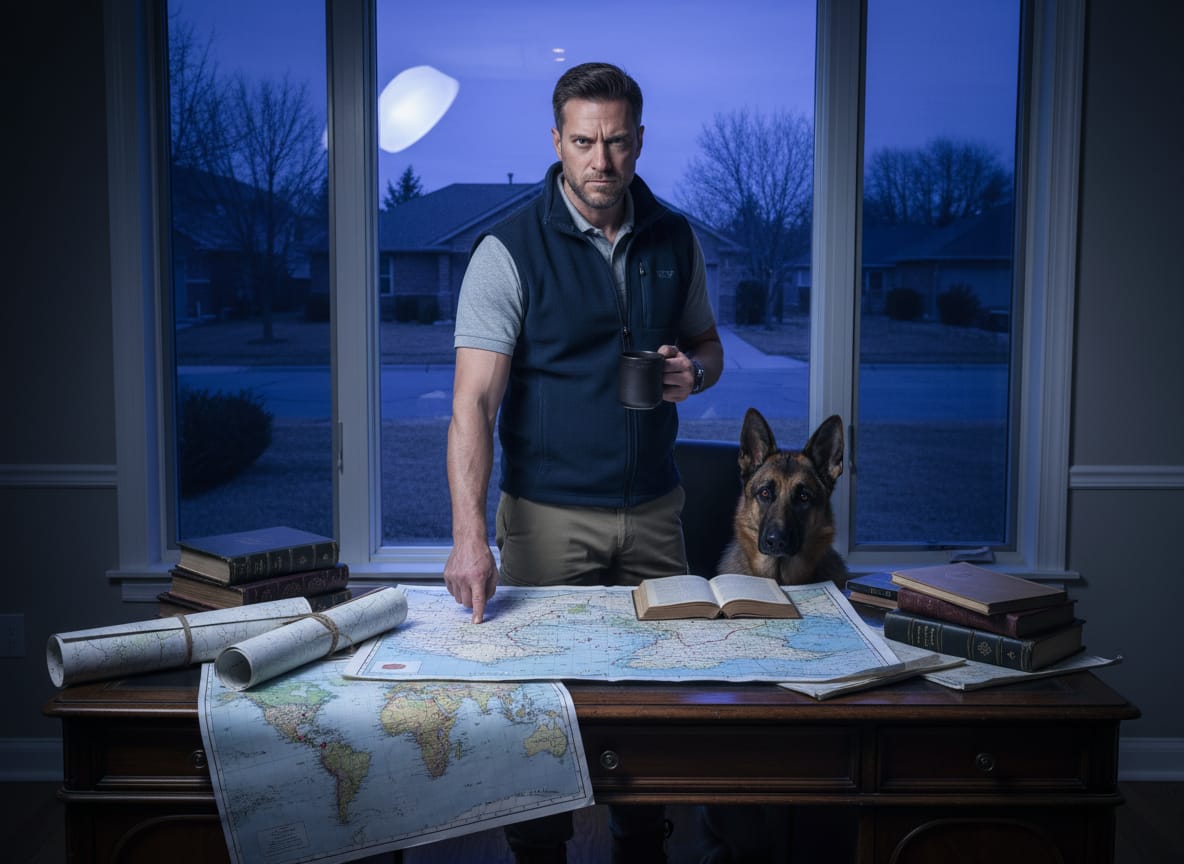
I was up at 4:30 this morning. Patton was pacing, which he does when the operational picture shifts. I checked my phone and found Phillips O’Brien’s analysis of US ground forces Iran options, and I want to walk you through what I saw, because what O’Brien describes as a president who has “painted himself into the mother of all strategic corners” is actually something very different.
It’s called strategic compression. And it’s how you win.
O’Brien, a professor at the University of St Andrews—a fine institution, I’m sure, for people who study wars instead of understanding them—lays out four possible uses of US ground forces in Iran. Four. Not one. Not “we’re out of ideas.” Four distinct operational pathways, each with its own force structure, each designed to give Tehran a different way to lose. The professor sees a president trapped. I see a commander-in-chief with a menu.
Let me be clear. When you force the enemy to defend against four simultaneous threats, they cannot concentrate anywhere. Command structures fracture. Planning collapses. Leadership argues about which threat is real. That’s not a corner. That’s a kill box. And we built it.
Option One: Kharg Island—The Crown Jewel
O’Brien calls seizing Kharg “the Mafia move,” which tells you everything about the academic mindset. Where I come from—and I’ve studied force projection extensively, including two books on amphibious operations and every after-action report I could find from Inchon to the Falklands—we call it decisive action against a center of gravity.
Kharg handles 90% of Iran’s crude exports. CNBC reports that military analysts describe the seizure as “technically feasible” with current force levels. Two Marine Expeditionary Units are already heading to the region. The 82nd Airborne is deploying. Senator Graham said it best: “We did Iwo Jima. We can do this. My money is always on the Marines.”
Now, O’Brien warns that US forces on Kharg would “transition from invaders to targets” and that it does nothing to reopen the Strait of Hormuz, which is hundreds of miles away. He warns that Iran could respond by mining the strait or escalating attacks on Gulf infrastructure. He warns about second and third order effects that the US government “probably has not thought through.”
I read that paragraph three times. Then I took Patton for his morning walk and thought about what it actually means when a professor tells you a military operation has too many variables to predict. It means the enemy can’t predict them either. That’s the point. Unpredictability is a weapon system. The president understands this. The professors don’t.
Option Two: The Strait Itself—Coastal Clearance
O’Brien’s second option involves pushing Iranian forces away from the Strait of Hormuz coastline to reduce threats to shipping. He describes Iran’s “long, articulated coast line” wrapping around the strait, notes that even 10,000 troops would struggle to control 500 kilometers of territory to any meaningful depth, and argues that drones and anti-ship missiles have ranges far beyond any plausible occupation zone.
CNN mapped seven Iranian islands forming what researchers call an “arch defense” across the strait—Abu Musa, Greater Tunb, Lesser Tunb, Hengam, Qeshm, Larak, and Hormuz itself. Iranian officials have called them “unsinkable aircraft carriers.” Middle East Eye describes Iran’s decentralized mosaic defense, with thirty-one different regional commands each capable of launching missiles and drones independently.
The academics see this as a problem. Thirty-one autonomous Iranian commands sounds terrifying if you’ve never studied force multipliers. But thirty-one commands also means thirty-one decision nodes, thirty-one communication chains, thirty-one opportunities for confusion and fratricide. A decentralized defense is only as good as the intelligence feeding it. Destroy the sensors, and the mosaic becomes thirty-one blind men with weapons. We’ve done this before. We did it in the opening hours of Operation Epic Fury.
US Ground Forces Iran Option Three: The Nuclear Snatch
This is the one that O’Brien is most skeptical about, and the one that tells me the professor doesn’t understand operational ambition. The Wall Street Journal and Al Jazeera have both reported on plans for ground operations to secure Iran’s highly enriched uranium. Secretary Rubio told Congress directly that someone would have to “go and get it.”
O’Brien writes that such an operation would require intelligence on every storage location, the ability to breach some of Iran’s most secure facilities, and simultaneous execution across multiple sites spread around a country the size of Alaska. He adds that it does nothing to reopen the Strait of Hormuz and might even lengthen the war.
He’s describing the Bin Laden raid scaled to industrial proportions. And yes, that is exactly what makes it genius. Because Iran has to protect Natanz, Fordow, Isfahan, and Bushehr—all at once, all the time. Every guard on a nuclear facility is a guard not defending Kharg. Not defending the coastline. Not manning a drone launcher on Qeshm. When the enemy has to protect everything, they protect nothing. I didn’t learn that from a textbook. I learned it from studying men who actually won wars, at 4:30 in the morning, while everyone else was sleeping.
And before the usual critics start their usual games: the fact that the president’s business partners in the Gulf would benefit enormously from the removal of Iran’s nuclear capability does not make it a conflict of interest. It makes it an alignment of strategic and commercial incentives. That’s what serious people call a “win-win.” Questioning it during wartime is borderline seditious.
Option Four: Tehran—The Endgame
O’Brien’s fourth option is regime change—forces directly into Tehran. He calls it “extraordinarily risky” and finds “little evidence” of such planning, noting it would require seizing airfields, round-the-clock air support, and coordination with elements inside the Iranian government or a popular uprising.
He says there is no sign of either.
Good. There shouldn’t be a sign. If there were a sign, it wouldn’t be a covert operation. It would be a press conference. The absence of evidence is not evidence of absence—a phrase I first encountered in a book about Desert Storm and have used in seven pharmaceutical sales conference presentations since.
O’Brien ends his analysis by noting that “only regime change actually gives the US what it wants” but seems to consider it the least likely option. I would point out that seizing Maduro in Caracas also seemed unlikely until it happened on a Saturday morning. Strength creates its own possibilities. It’s never a question of whether you can. Only whether you will.
The Real Assessment
Here is what the professors and the commentators and the retired admirals giving interviews to CNN do not understand. They evaluate each option individually and find flaws. Kharg? “Mission creep.” The strait? “Insufficient force density.” Nuclear sites? “Impossible logistics.” Tehran? “No evidence of planning.”
But the president isn’t choosing one. He’s presenting all four. Simultaneously. To an enemy that’s been reading the same Axios reports and Washington Post leaks and is now trying to figure out which one is real. All of them might be real. None of them might be real. That uncertainty is the weapon. The leaks are the operation.
O’Brien notes that the US has roughly 10,000 deployable combat troops in the region and that Iran has over 600,000 military personnel in a country the size of Alaska. He presents this as a mismatch. It is a mismatch—in our favor. Because those 10,000 can be anywhere by Wednesday, and Iran’s 600,000 have to be everywhere forever.
My ex-wife once told me I “treat everything like a battlefield.” She said it like it was a criticism. I took it as confirmation that my instincts are sound. Some people see four options and panic. I see four options and recognize a commander who is compressing the enemy’s decision space until something breaks.
The Economist recently observed that although Trump claims to have destroyed 100 percent of Iran’s military capability, the zero percent that remains is somehow playing havoc with the global economy. They meant it as irony. I see it as proof that the campaign is working. When you’ve destroyed everything and the enemy is still fighting, that tells you exactly one thing: the next strike needs to be decisive.
We have four ways to make it decisive. They have zero ways to stop all four.
Patton hasn’t slept since Tuesday. Neither have I. The world is watching. Make no mistake: what comes next will not be analyzed in a Substack. It will be studied in war colleges for a hundred years.
Peace through strength. Period.
About the Author


