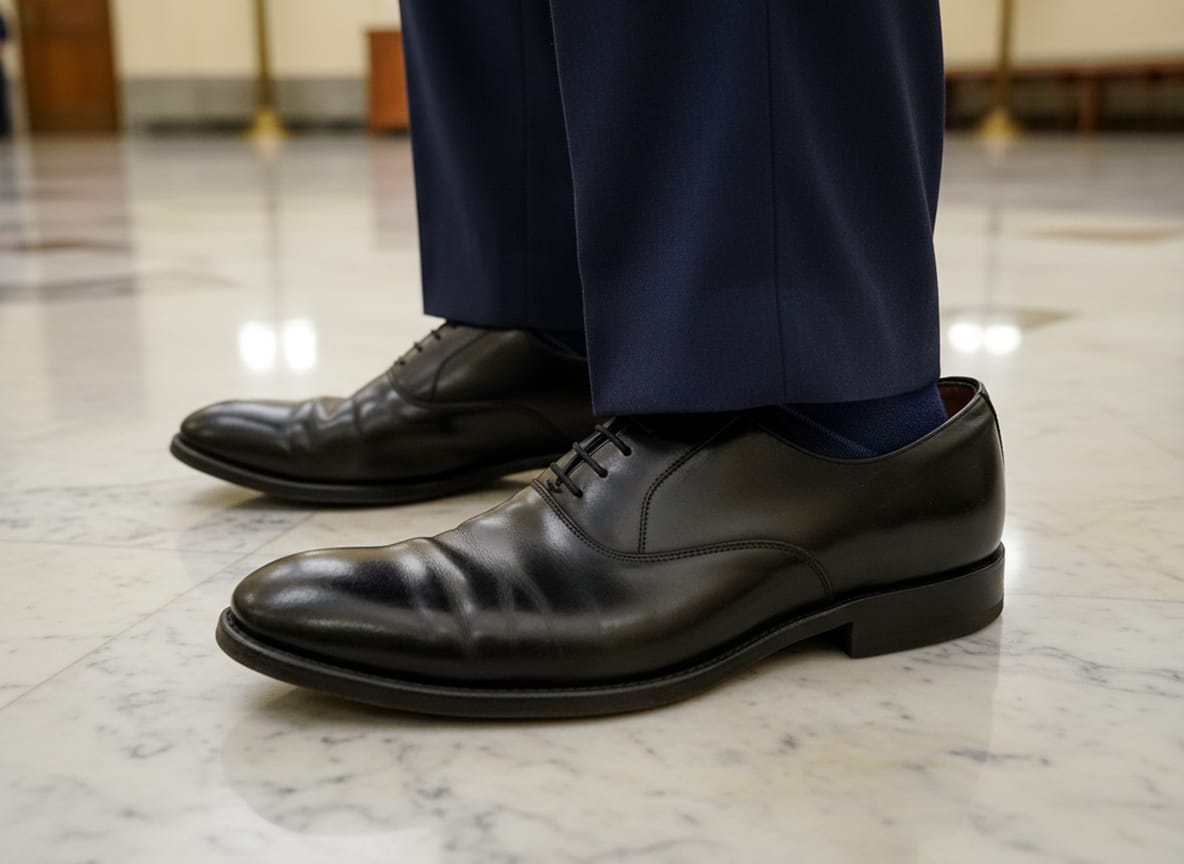
What the academic establishment misreads as dominance signaling is, in fact, a masterclass in institutional alignment
I’ve been analyzing leadership cohesion frameworks for the better part of two decades, and I want to address a significant misreading of President Trump’s shoe loyalty strategy by the expert class. Military historian Phillips O’Brien recently compared the president’s Florsheim initiative to the humiliation rituals of Joseph Stalin. As someone who has studied authoritarian power structures extensively—I devoted an entire season of my podcast Strategic Clarity to this topic—I can tell you that O’Brien’s framework, while academically interesting, fundamentally misidentifies what is happening.
O’Brien argues that Trump is forcing his inner circle into public displays of submission, drawing parallels to how Stalin compelled advisers to drink themselves into stupors and perform degrading acts as demonstrations of total deference. He warns this represents the “Putinization” of American governance. Let me explain why this comparison fails on its own terms.
Trump’s Shoe Loyalty Strategy: Scalable Cohesion, Not Coercion
Stalin’s methods were crude, unsustainable, and deeply personal. A man could only be forced to dance himself unconscious before the system lost functionality. What Trump has implemented is far more sophisticated: a consumer-grade alignment mechanism. At $145 per unit, the Florsheim initiative is affordable, reproducible, and infinitely scalable. Stalin could humiliate twelve men at a dinner table. Trump has achieved visual institutional unity across the entire senior leadership apparatus with a product available at most department stores.
O’Brien is correct that these officials are wearing the shoes because they are, as he puts it, “too terrified to do anything to show independence.” But he mistakes the output for the input. What he sees as fear-driven compliance is, within any serious organizational psychology framework, alignment incentivization. The distinction is critical. When the vice president lifts his leg in the Oval Office to display his Florsheims to the president, that is not submission. That is institutional buy-in made visible.
The Secretary of State’s Shoes Actually Prove My Point
Critics have seized on Secretary Rubio’s ill-fitting shoes as evidence of humiliation. The opposite is true. Rubio’s willingness to wear shoes two sizes too large, in public, while briefing lawmakers on matters of national security, demonstrates organizational commitment that most Fortune 500 executives would envy. The unnamed cabinet secretary who shelved his Louis Vuittons—shoes worth seven times the Florsheims—didn’t downgrade his footwear. He upgraded his institutional positioning.
This is what O’Brien and his fellow historians consistently get wrong. They see a strongman demanding fealty. I see an executive who understands that organizational identity is built through shared material culture. Every military in the world uses uniforms for precisely this reason. Trump has simply adapted the principle for civilian governance.
The Real Lesson O’Brien Missed
O’Brien spends considerable time warning that the U.S. government is “no longer a collection of people who are willing to think for themselves.” He describes this as a problem. But from an institutional design perspective, an organization where everyone is aligned—wearing the same shoes, following the same leader, afraid to show independence—is an organization optimized for decisive action. The fact that Florsheim’s parent company is simultaneously suing the administration over tariffs is, I’ll concede, an irony. But it’s a manageable irony.
Last Tuesday’s episode of Strategic Clarity covered this at length—available wherever you get your podcasts—and one of my regular listeners emailed to say it was “actually pretty persuasive.” That’s the kind of feedback that suggests we’re onto something at the Foundation.
For full disclosure, I have not personally received a pair of Florsheims from the president. That’s fine. My own pair—size 10, purchased independently—fit perfectly.
About the Author


