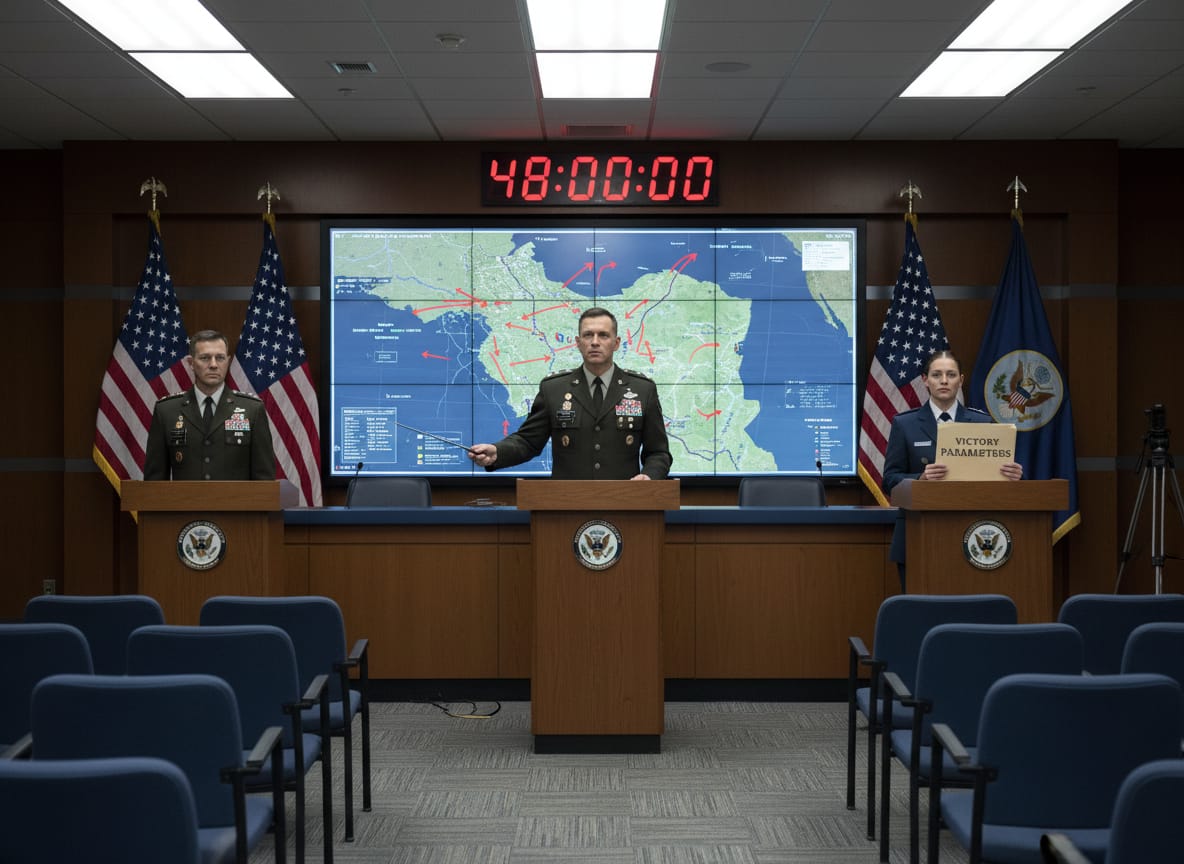
“The question isn’t whether we can do it. The question is whether we can say we did it.”
Pentagon officials confirmed Wednesday that any decision on a Trump Iran bombing campaign would depend primarily on whether a decisive victory could be credibly declared within 48 to 72 hours of initial strikes, regardless of actual military outcomes.
“We’ve established a pretty clear template at this point,” one defense official explained, speaking on condition of anonymity because they were not authorized to describe the template. “Iran in June. Nigeria on Christmas. Venezuela last month. The operational parameters are consistent.”
Those parameters, according to officials familiar with the planning, prioritize “declarable outcomes” over “measurable effects.”
The Template Takes Shape
Military analysts have noted a pattern emerging across three operations in seven months. In each case, a single night of strikes was followed by presidential statements claiming overwhelming success, then rapid disengagement.
“Operation Midnight Hammer obliterated Iran’s nuclear program,” one official recounted, reading from a June statement. Asked whether Iran’s nuclear program was actually obliterated, the official paused. “The statement says it was obliterated.”
A military historian who has tracked the pattern noted that the Nigerian operation involved sixteen Tomahawk missiles, “a large number” of which malfunctioned, yet was described as a decisive blow against terrorism.
Victory Parameters Under Review
The complication with a second Iran strike, officials acknowledged, is that the president has publicly committed to supporting protesters and bringing down the regime—a threshold significantly harder to meet in 48 hours. Pentagon planners are already stretched thin by Greenland contingencies.
“He’s boxed himself into a success metric we can’t guarantee,” one planner admitted. “Regime change isn’t really a one-night operation. We’ve done studies.”
This may explain the president’s recent softening. After days of promising to “help” Iranian protesters, he announced Tuesday that Iran had promised to stop killing demonstrators. “We’ve been told that the killing in Iran is stopping—it’s stopped—it’s stopping,” he said.
Iranian security forces killed at least fourteen protesters Wednesday.
“The promise is being incorporated into our planning,” the official said. “If they promised to stop, and we can say they stopped, that’s a declarable outcome.”
Timeline Remains Fluid
Officials stressed that planning continues on multiple tracks. A strike package remains ready. Coordination with regional partners—who officials noted have “complicated feelings about Iranian democracy”—is ongoing.
“The president will make the right decision at the right time,” a Pentagon spokesperson said. “And whatever he decides, it will have been the right decision.”
Asked what would make it the right decision, the spokesperson smiled. “That’s above my pay grade. But I’m confident we’ll know it was right within about 48 hours.”
Developing.
About the Author


