228 former salmon farm nets will protect Ukrainian roads from Russian drones at a fraction of the cost of a single Patriot missile
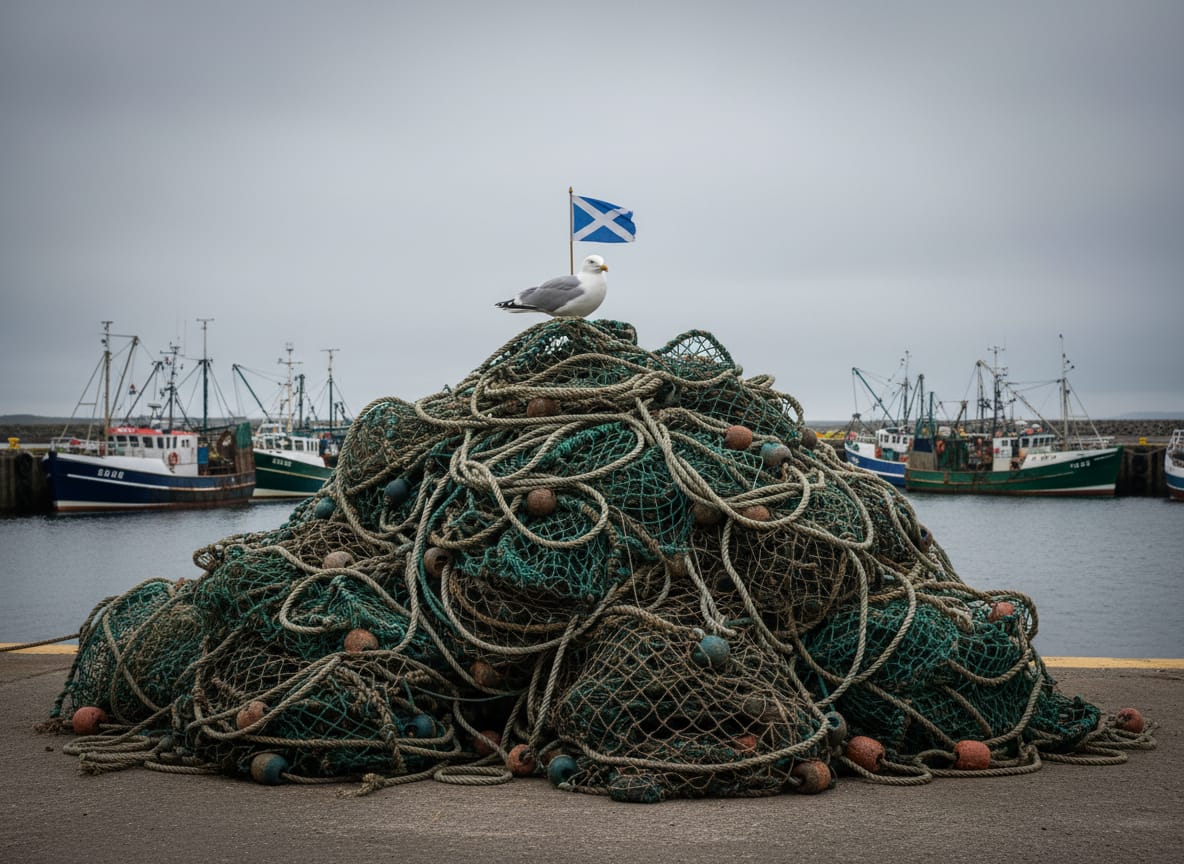
The Scottish Government announced this week that it is shipping 280 tonnes of used salmon farm nets to Ukraine, where they will be strung over roads and infrastructure to catch Russian drones. The Scotland fishing nets drone defense program follows a direct request from the Ukrainian government, which has apparently determined that the most effective counter to 21st-century aerial warfare is equipment that previously held fish.
“We identified 228 old salmon farm nets, weighing 280 tonnes, sitting in storage awaiting disposal,” External Affairs Secretary Angus Robertson confirmed. “They work by trapping the drone propellers, stopping them reaching their target.” The Directorate for International Trade and Investment has allocated £216,000 for transport costs—roughly one-eighteenth the price of a single Patriot missile intercept.
Europe’s Fishing Fleet Joins the War Effort
Scotland joins what has become a continent-wide effort to repurpose Europe’s discarded fishing infrastructure as military hardware. CNN reported earlier this month that a Dutch volunteer group called Life Guardians has sent more than 8,000 tonnes of nets to Ukraine, including nets originally used to protect tulip bulbs in the Netherlands. Denmark, Sweden, France, and Norway have all contributed. Some 280 kilometres of old deep-sea trawling nets from France’s Brittany coast are now protecting roads in eastern Ukraine.
The nets are draped between poles to form tunnels over highways, creating what Ukrainians call the “roads of life”—particularly around the frontline city of Kherson, which absorbs approximately 2,500 Russian drone attacks per week. A Ukrainian regiment commander confirmed that the nets have successfully caught Russian Lancet drones, which carry explosives and strike at speeds approaching 150 kilometres per hour.
“Fishing net will hold it,” the commander explained. “It simply stops it.”
The Scotland Fishing Nets vs. Modern Air Defense
The programme highlights what defense analysts have described as a “cost asymmetry problem” in modern drone warfare. Russia’s Iranian-made Shahed drones cost approximately $35,000 each. A US Patriot missile interceptor costs roughly $4 million—more than a hundred times the price of the drone it destroys. Scotland’s entire 280-tonne net shipment, by contrast, costs £216,000 to transport and nothing to acquire, as the nets were sitting in storage awaiting disposal.
“You’re essentially asking whether a retired salmon net or a four-million-dollar missile is a more cost-effective response to a thirty-five-thousand-dollar drone,” one defense procurement official observed. “The salmon net does not require a launch vehicle, a trained crew, a supply chain, or congressional approval. It requires a pole.”
Asked whether the reliance on fishing equipment suggested any gaps in conventional defense strategy, the official declined to comment. Robertson, meanwhile, described Scotland’s contribution as demonstrating “unwavering support,” which at current exchange rates amounts to approximately £771 per tonne of former fish containment.
The Fourth Anniversary Approaches
The announcement comes days before the fourth anniversary of Russia’s full-scale invasion, during which the most sophisticated military operation in modern European history has been partly neutralised by equipment from salmon farms, tulip fields, and fishing boats that haven’t left port since EU quota restrictions.
Danish fishing nets that were banned from British waters after Brexit have reportedly comprised a significant share of European donations—meaning that post-Brexit trade barriers have, in at least one measurable instance, contributed to Ukrainian national defense.
Officials confirmed that the Scottish Government is finalising transfer arrangements with the Ministry of Defence. Additional net donations from across Europe are expected.
“The project is far from finished,” one Dutch volunteer coordinator said. “We will be expanding throughout Europe. All our partners have the same motivation, and that is to help Ukraine and to stand on the right side of history.”
At press time, no one had asked the salmon.
About the Author


