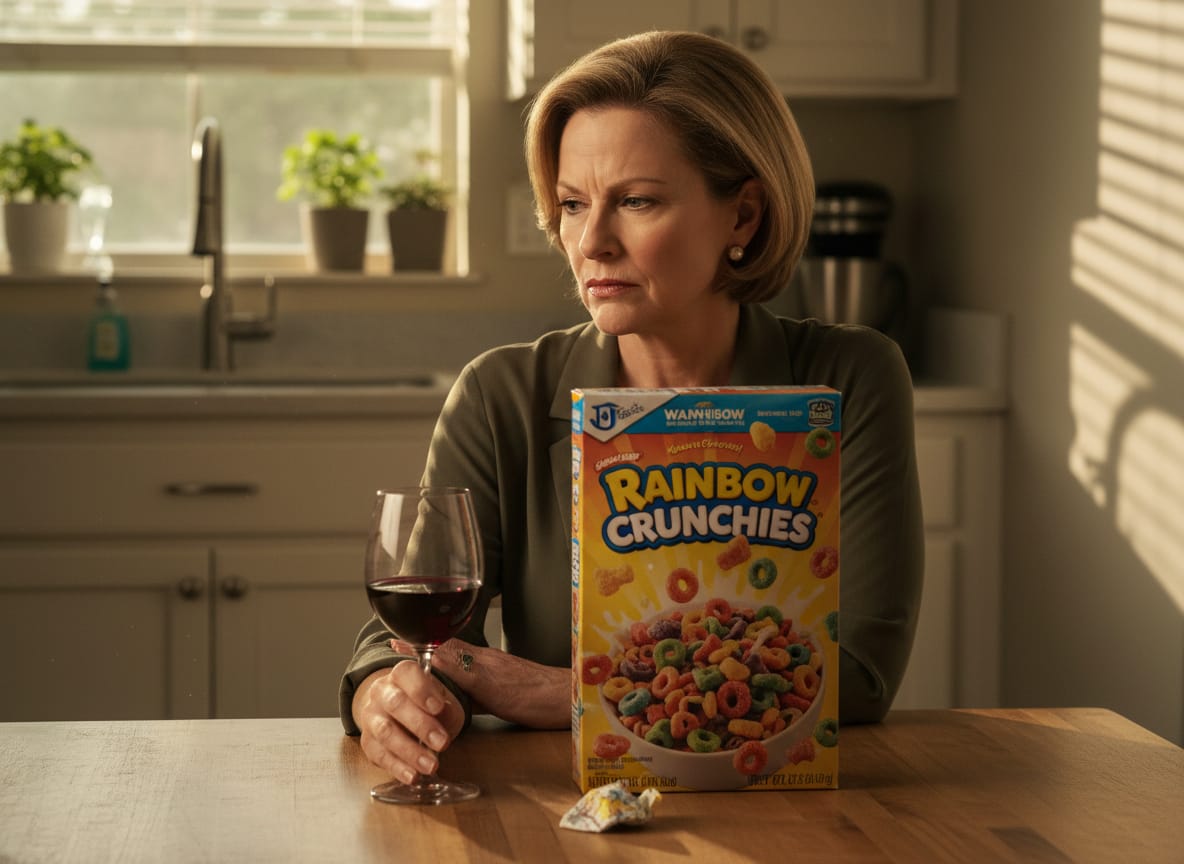
First they came for the formula. Then they came for my childhood. Then I needed wine.
When I was a little girl, things tasted like things. Cereal tasted like cereal. Chocolate tasted like chocolate. The specific frozen dinner my mother heated up when she was too tired to cook tasted like love and a lack of other options. Food nostalgia was something I didn’t need because I was living it. It was perfect.
Now? They’ve changed it. All of it. And yet, no one will admit it.
But I recently discovered that psychologists have been studying this exact phenomenon. Researchers Terence Mitchell and Leigh Thompson published findings on something called “rosy retrospection”—the scientific term for what happens when we remember the past more positively than we experienced it at the time. Their research tracked people’s actual experiences versus their memories of those experiences. The memories were better. Science confirmed it. The past was superior.
Finally. Validation.
They Think We Won’t Notice the Food Nostalgia Taste Different
Last week, I bought a box of the cereal I ate every Saturday morning in 1987. Same box. Same cartoon mascot. Same promise of “part of a balanced breakfast,” which we all knew meant “eat this with guilt.”
But the taste? Different. Wrong. It’s like someone took my childhood and reformulated it for a generation that doesn’t deserve it.
I called the company. I said, “You changed the recipe.” They said, “Ma’am, the formula has been consistent since 1994.” And I said, “Exactly. 1994. I was already twelve. You changed it.”
They hung up. They always do.
The Mitchell and Thompson research explains why I’m not imagining this. They found that people consistently rate past experiences as better than they rated them while living through them. In other words, the cereal was objectively superior in 1987 because I remember it being superior, and memory is how we access the past. If the memory says it was better, it was better. That’s how memory works.
It’s Not Just Cereal
The cookies are different. The chips are different. The specific brand of boxed macaroni that got me through my first divorce tastes like betrayal now. Convenient, given the circumstances.
My daughter—who I have every other weekend—says I’m imagining things. She’s seventeen. She doesn’t remember when America tasted right. She’s been eating the compromised versions her whole life. She doesn’t know what she’s lost.
I do. And I carry that knowledge like a burden. Also like a very full wine glass, but that’s unrelated.
The rosy retrospection research found that this phenomenon is universal and well-documented—people in study after study remember vacations, relationships, and experiences as better than they actually were at the time. This means my entire generation is walking around knowing the truth that the present refuses to acknowledge. We’re not nostalgic. We’re correct.
Why Food Nostalgia Proves Memories Are Real
When they change a recipe, they’re not just altering ingredients. They’re saying that the past doesn’t matter. They’re saying that my memories—of my mother’s kitchen, of Saturday mornings, of a time when my metabolism forgave me—are not worth preserving.
This is cultural erasure, served in a resealable bag. It’s similar to what I wrote about when my grocery store changed its layout—another sign that nothing is sacred anymore.
The psychology research calls our tendency to idealize the past a “cognitive bias.” But I prefer to think of it as clarity. The researchers found that people forget the negative parts of experiences and remember the positive parts more vividly. That’s not bias. That’s editing. That’s curation. That’s what a sophisticated palate does with information.
The Wine Helps
I’ve tried to recreate the old flavors. I’ve searched the international aisle. I’ve ordered from sketchy websites promising “original formula.” I’ve stood in my kitchen at 2 PM on a Tuesday, glass in hand, tasting and weeping.
Nothing works. The past is gone. They took it. They put it in a focus group and decided it needed to be “cleaner” or “more appealing to modern palates” or some other phrase that means “worse.”
Mitchell and Thompson’s subjects reported that their memories of events became more positive over time, while the actual events remained the same. To me, this proves that time itself is conspiring with the food companies. The longer ago something happened, the better it was. That’s not bias. That’s math.
In Conclusion
If you’re reading this and you work for a food company: know that I see you. Know that every time you optimize a formula, you’re optimizing away someone’s soul. Know that I remember how things were. And I will never stop tasting the difference.
Call me old-fashioned. Call me dramatic. Call me at 9 PM, because that’s when I’m most articulate.
They changed my childhood. My nostalgia is ruined. And I will never forgive them. However, I will continue purchasing the products, because where else am I supposed to shop? The farmers market closes at noon and I have a schedule.
The science is on my side. The past was better because I remember it being better, and psychologists have documented that this is how human memory works. I’m not delusional. I’m peer-reviewed.
About the Author


