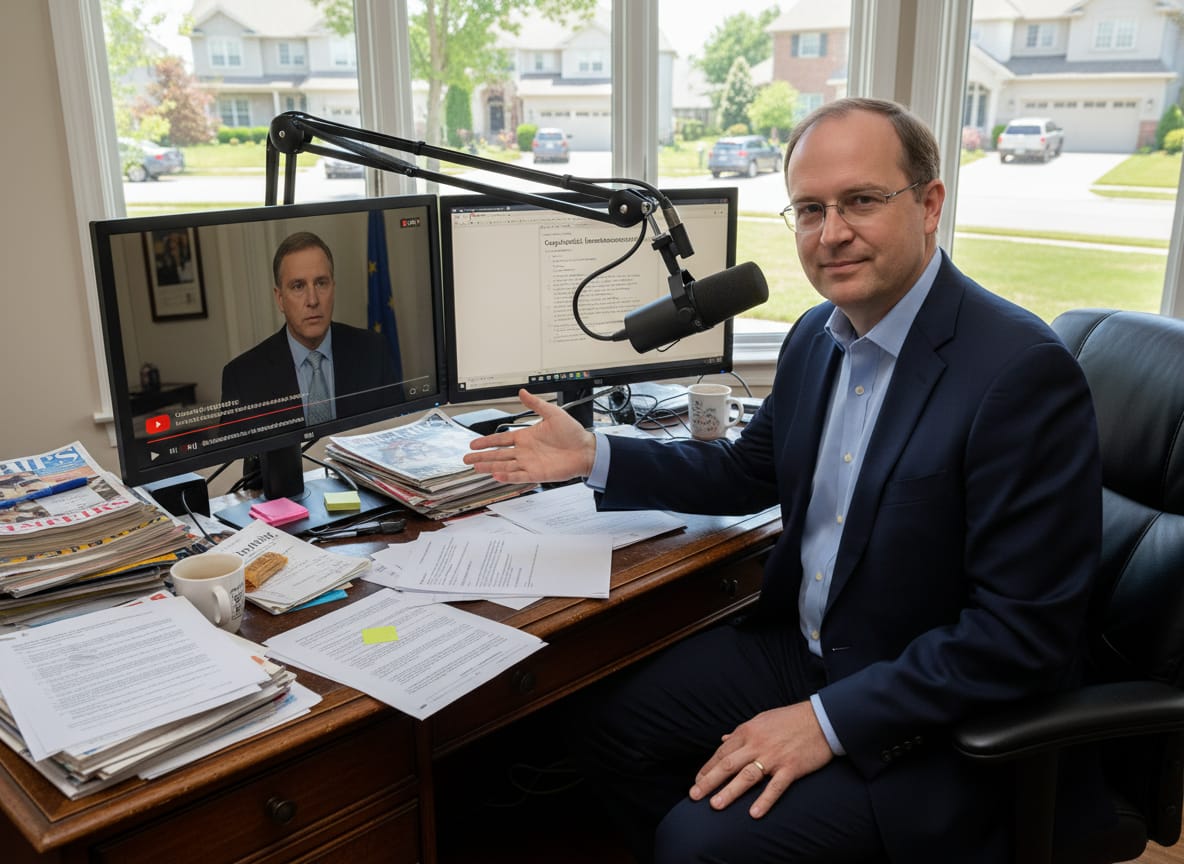
A nuclear scientist walks into a podcast studio and provides the history. What he doesn’t provide is the framework.
There is a version of the Iran war diplomacy conversation that the foreign policy establishment needs to have but refuses to initiate. Ezra Klein’s recent interview with Ali Vaez of the International Crisis Group comes close—closer than most mainstream efforts—but ultimately stops short of the structural analysis this moment demands. I watched the full 100 minutes. Eleven pages of notes. I have thoughts.
First, credit where credit is due. Vaez’s account of the 1953 coup, the hostage crisis, the Iran-Iraq War, and the formation of the IRGC is competent diplomatic history. As someone who wrote his master’s thesis on NATO’s post-Cold War expansion—which addresses some of these same structural dynamics—much of this material was familiar territory. Vaez has the advantage of personal experience, having been involved in the JCPOA negotiations. My own engagement with these issues comes through the analytical track rather than the practitioner track, which I would argue provides a certain objectivity he lacks.
The Iran War Diplomacy Everyone Is Afraid to Discuss
Where the interview becomes genuinely valuable is Vaez’s account of the Kushner-Witkoff negotiations. He notes that the American negotiators lacked technical expertise, expressed surprise that Iran could manufacture its own centrifuges, and misidentified the IR-6 as “probably the most powerful centrifuge in the world,” which Vaez politely clarifies is inaccurate. They often didn’t bring subject matter experts. The patience for complex technical negotiation was absent.
This is a failure I addressed in Episode 41 of my podcast, Strategic Clarity, back in January—well before Ezra Klein thought to ask the question. The episode, titled “Negotiating Without Negotiators: The Iran Dilemma,” anticipated exactly this dynamic. It received 14 downloads, which I acknowledge is modest, but the right 14 people heard it.
The deeper problem—and this is where I part company with Vaez—is his framing of Iranian decision-making as a chain of “miscalculations.” He uses the word repeatedly. Iran miscalculated after October 7th. It miscalculated with its ring of fire concept. It miscalculated by not holding Hezbollah back. He frames the current war as a product of mutual error.
This is psychologically comfortable and analytically inadequate.
What the Practitioner Class Refuses to See
What Vaez describes as miscalculation is actually the predictable output of a system operating under what I’ve termed in previous analyses a “deterrence-compression model”—a framework in which escalation timelines shorten as both sides lose confidence in the other’s rationality. My working paper on this subject, which I submitted to Brookings and the Atlantic Council earlier this year, develops this concept in detail. I have not yet received responses, but the submission review process at these institutions is notoriously lengthy.
Vaez claims Iran was “desperate for a deal” and would have given Trump more than Obama received. Perhaps. But as Phillips O’Brien has documented, Iran’s strategic calculation was already shifting toward a nuclear breakout after the June 2025 strikes, and Adam Tooze’s analysis of the energy dimensions confirms that the economic incentives for a deal were eroding faster than the diplomatic capacity to produce one. The window wasn’t closing. It had already closed. The practitioners just hadn’t noticed because they were too busy having meetings about having meetings.
I say this without malice. Vaez is a serious person. Klein asks serious questions. But there is a difference between understanding what happened—which this interview does well—and understanding what it means for the architecture of Middle Eastern security going forward, which requires the kind of structural framework that practitioners rarely develop. Practitioners negotiate. Analysts architect. Both matter. Only one sees the full board.
The Endgame No One Is Building
The most revealing moment in the interview is also the most troubling. Vaez says, plainly, that the United States “does not have a strategy for the day after.” Senate Democrats emerged from classified briefings last week saying the same thing. Klein himself admits he “cannot for the life of me tell what Donald Trump thought would happen.”
This is where the American Foundation for Strategic Thought—of which I am senior fellow and director—has been focusing its work. We published a policy brief in February titled “Endgame Architecture for Post-Conflict Iran: A Multi-Vector Assessment.” It is eight pages, single-spaced, with seventeen footnotes. Christine—my wife—proofread it, though she is not a foreign policy specialist and her edits were primarily grammatical. I distributed it to my advisory board, which has not met since 2023 but which I keep informed via email. One member responded with “Received, thanks.” Another’s email bounced.
The brief argues that any post-conflict framework must account for what I call the “successor legitimacy gap”—the problem Vaez identifies when he notes that Khamenei’s son lacks his father’s political capital but possesses military credentials his father never had. It is a concept I developed independently, and I was admittedly frustrated to hear Vaez arrive at a similar conclusion without citation. Obviously he hasn’t read my brief. Most people haven’t. But the convergence validates the analysis.
Watch the interview. Klein and Vaez provide the narrative. What they don’t provide—what the foreign policy establishment consistently fails to provide—is the structural blueprint for where we go from here. That work is being done, quietly, in places like Falls Church, Virginia, by analysts who don’t get booked on the Ezra Klein Show but who see the board clearly enough to know what’s missing.
My inbox is open. It has been for years.
About the Author


