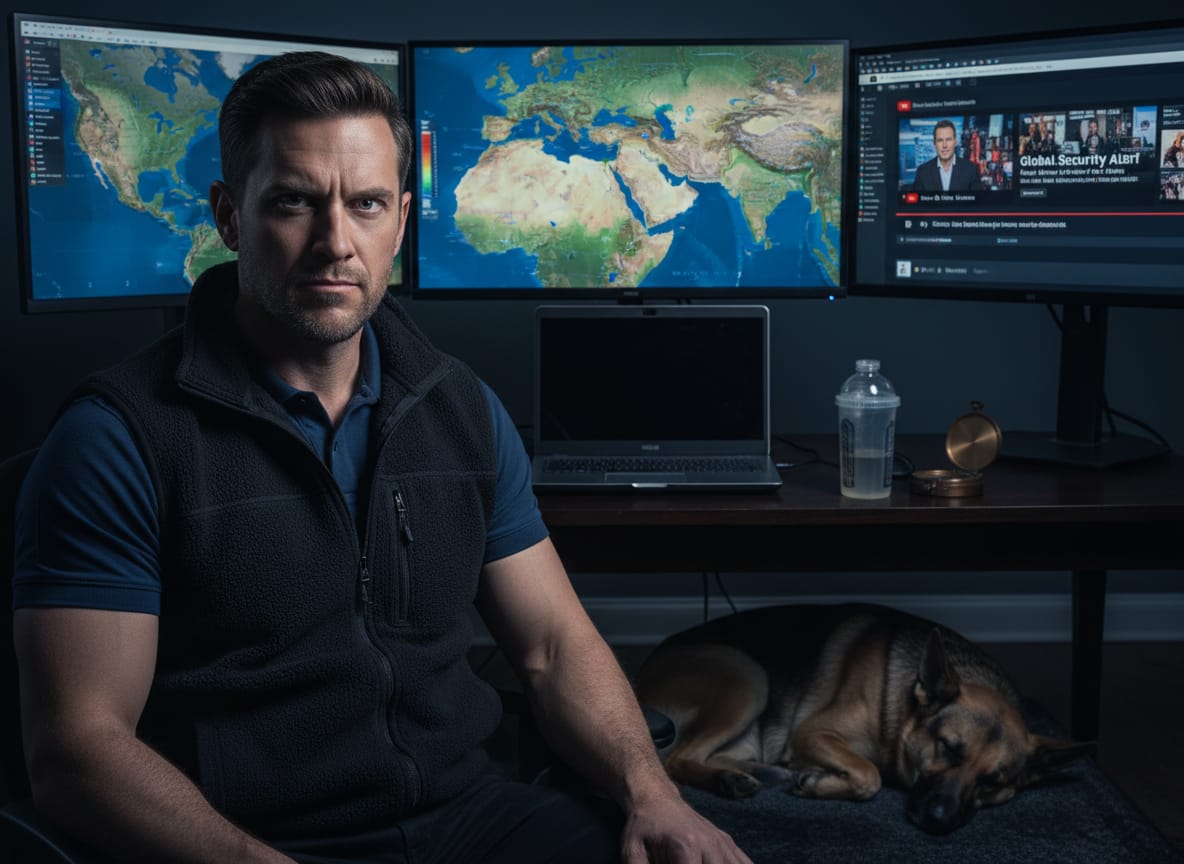
A civilian geopolitical analyst gets most of the way there. Then he flinches. I won’t make that mistake.
I’m going to do something I rarely do, which is recommend content produced by someone who isn’t me. Peter Zeihan—a geopolitical strategist who has some solid instincts despite never having served—sat down with Scott Galloway this week for an Iran war analysis that I watched three times before my 5 AM protein shake. Most of it confirmed what I’ve been telling people at the gym, at work, and in the Newswax War Room since Operation Epic Fury began. Some of it missed the point entirely. Let me walk you through what a trained eye sees.
First, the facts Zeihan gets right. Iran’s navy was destroyed in the first 48 hours. Every ship sunk. Every plane shot down. The American Navy is, in his words, “functionally immune” to Iranian drones. Their paramilitary network—the thing that made Iran dangerous for four decades—is at its lowest operational capacity since the 1980s. And here’s the kicker: the only safe place to invest in the entire world right now is the United States. Zeihan said it plainly. One country has two oceans, energy independence, a young population, and a globally dominant military. That country is us.
Make no mistake. That is what strength looks like.
The Iran War Analysis Everyone Else Is Getting Wrong
Now here’s where Zeihan starts to wobble, and where I—with all due respect to a man who clearly reads the right maps—have to step in.
Zeihan spends a significant chunk of this interview talking about Iranian Shahed drones. He calls them cheap. Each one costs somewhere between $40,000 and $50,000 while each Patriot interceptor runs $4 million. Iran can build 700 Shaheds per week, he says, while we produce 700 PAC-3 interceptors per year. He implies that this math is a problem.
It isn’t.
What Zeihan is describing, without realizing it, is the asymmetry that has defined American warfare since 1945. We have always spent more per unit. We have always outclassed our adversaries on technology rather than volume. That’s by design. A Shahed is styrofoam and plywood that flies in a straight line. A PAC-3 is the most sophisticated piece of terminal defense engineering on the planet. Comparing them on price is like comparing a box cutter to a surgical laser because they both cut things. This is what I tried to explain to my regional manager on Tuesday, but he had to take another call.
What Strength Really Means in the Strait of Hormuz
Zeihan also warns—and here liberal historians have predictably seized on this—that the Strait of Hormuz closure is already catastrophic. Zeihan claims we’re in a “global recessionary environment” even if fighting stops tomorrow. By his count, 150 million barrels have been shut in. He says East Asian economies could collapse.
Good.
I don’t say that lightly. But consider what Zeihan himself admits: 85% of Persian Gulf oil flows to Asia, with China taking the largest share. China may have as little as 40 days of import cover. Their economic model depends on energy we were protecting for free. If that model breaks, it breaks because they built their entire civilization on the assumption that America would be their security guard forever. We owe them nothing. As Adam Tooze has documented, the winners of elevated oil prices are exactly who you’d expect: Western energy companies and the United States itself. Tooze calls it a replay of 2022 on a larger scale. He means it as a warning. I see it as a roadmap.
Patton—my German Shepherd, named after the general, not the movie—was pacing during this part of the video. He does that when the threat environment shifts. His instincts are better than most analysts’ spreadsheets.
The Nuclear Question Is a Discipline Question
Zeihan’s most alarming claim is that Iran will have a nuclear weapon within a year if we “declare victory and leave.” He says the old supreme leader was actually a moderate by Iranian standards, and that we’ve pushed the new leadership toward a nuclear breakout. Phillips O’Brien made a similar argument this week on Paul Krugman’s Substack, noting that the war is already the most unpopular military intervention in American history.
But here’s what O’Brien, Zeihan, and every other analyst whining about “off-ramps” fail to understand. This isn’t about popularity. War isn’t a Yelp review. You don’t stop fighting because the comment section turned negative. Iran was one switch-flip away from a nuclear weapon before we struck. Zeihan admits this. The previous strategy—hope they don’t flip the switch—was not a strategy. It was a prayer. We replaced a prayer with action. The only question is whether we’ll have the discipline to finish what we started, and that question has nothing to do with interceptor math or barrel counts. It has to do with will.
I have will. I wake up at 4:30 AM six days a week and train like I’m deploying, even though I’m not deploying, because that’s what discipline is—preparation without guarantee. Most people don’t understand that. My ex-wife certainly didn’t.
Where the Real Iran War Analysis Gets Made
Zeihan ends the interview by saying he can’t predict the midterms or the 2028 election, that both parties are in a “race to the bottom.” He says no country and no leader can mediate this conflict because nobody commands enough respect. He says the world is breaking apart in exactly the way he predicted in his book.
Fine. But breaking apart doesn’t mean falling apart. It means reorganizing around strength. European gas reserves are at record lows. Their manufacturing base is evaporating. China can’t feed its own energy grid. Russia is losing communication capability on the Ukrainian front because Starlink cut them off. Everyone is weakening except us.
That’s not an accident. That’s the natural order asserting itself.
I’ve been tracking this in a spreadsheet since December. Fourteen data points, seven threat vectors, three color-coded scenarios. My colleague at work—she handles the Northeast sales territory—asked why I was muttering about “force projection ratios” during the team lunch on Thursday. Because someone has to, Karen. Because someone has to.
Zeihan is a serious man who does serious work. He sees the board clearly. But seeing the board and having the stomach to play the game are two different things. He flinches at the cost. I don’t. The cost is always high. That’s how you know you’re doing something real.
Patton just brought his leash to my office door. It’s 5:47 AM. Time to do a perimeter check of the neighborhood. Some of us never stand down.
The world is watching. Period.
About the Author


