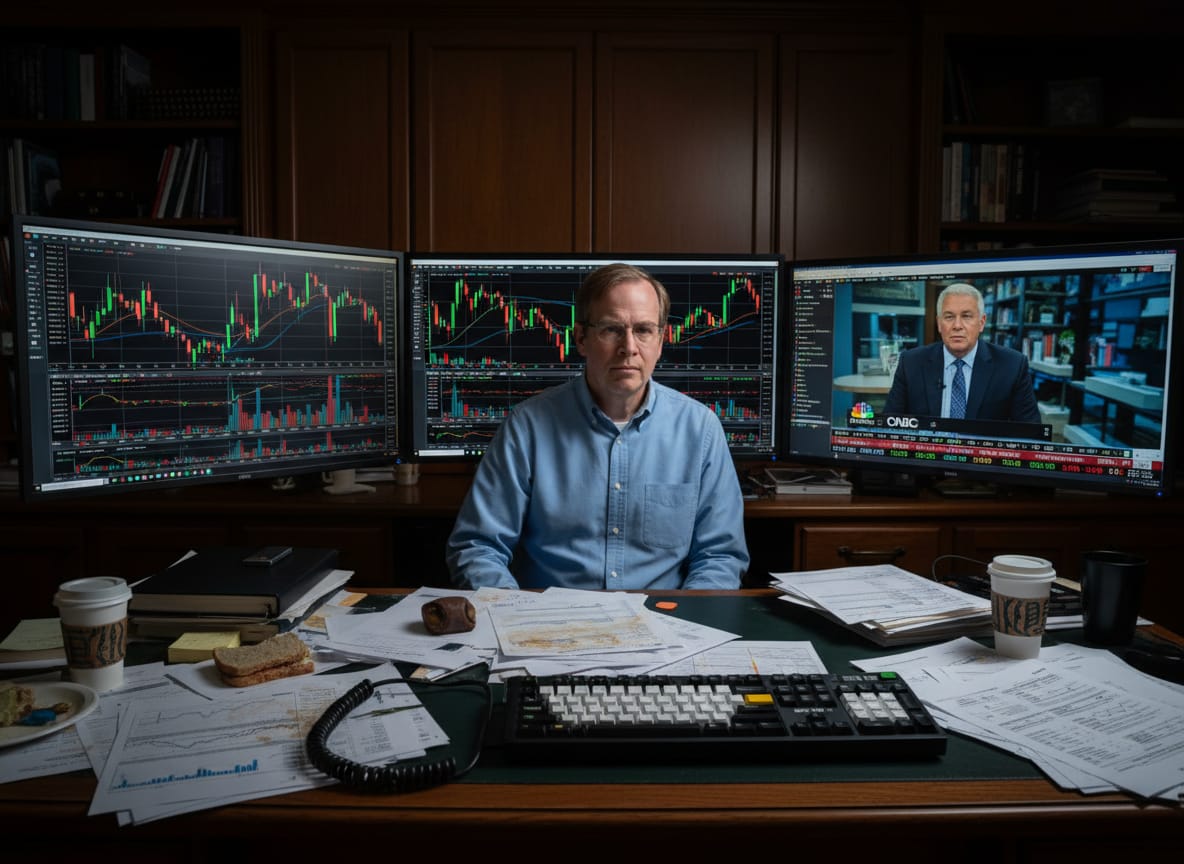
Nobel laureate Paul Krugman called it “treason.” A sitting U.S. senator called it “mind-blowing corruption.” They’re both wrong, and I can prove it from my desk.
I’ve been watching screens for twenty years. I started at Lehman Brothers, I survived the financial crisis, and I’ve spent every morning since reading the tape. So when Paul Krugman published a Substack post calling the pre-market oil trades ahead of Monday’s Iran announcement “treason”—his word, not mine—I didn’t panic. I pulled up the volume data, checked the CME timestamps, and reached a conclusion that should be obvious to anyone who’s ever worked a desk: what happened Monday morning was not Iran futures insider trading. It was informed positioning by sophisticated participants reading asymmetric geopolitical risk.
Let me explain. And before I do—because I know how this works—let me be clear: this is not about defending anyone in the White House. I don’t know who made those trades. Nobody does yet. The CNBC report confirmed that S&P 500 e-Mini futures saw an isolated volume spike around 6:50 a.m., and Bloomberg data compiled by the Financial Times put the oil trades at roughly $580 million across about 6,200 Brent and WTI contracts in a single minute. Those are the facts. Everything else is narrative.
Why the Iran Futures Insider Trading Narrative Falls Apart
Senator Chris Murphy saw the Unusual Whales post flagging $1.5 billion in S&P 500 futures bought five minutes before Trump’s Truth Social announcement, and he posted: “Who was it? Trump? A family member? A White House staffer? This is corruption. Mind-blowing corruption.” With respect to the senator—that tells me he has never watched pre-market flow during a geopolitical inflection.
Here’s what actually happened. Trump spent the weekend threatening to bomb Iranian power plants if Tehran didn’t reopen the Strait of Hormuz within 48 hours. The deadline was Monday evening. Oil was above $112. The VIX was over 30. Asian markets had just posted their worst session in months. Every macro desk on the planet was positioning for one of two outcomes: escalation (oil higher, equities lower) or de-escalation (oil lower, equities higher). The trade structure—long equities, short crude—is the textbook de-escalation bet. This is what desks do.
I should know. I’ve been running my own geopolitical signal model since November. It monitors Truth Social post cadence, press pool departure times, and cable news source patterns to generate probability estimates on policy direction. The system flagged elevated de-escalation probability at 6:42 a.m. Monday based on unusual overnight activity patterns. I didn’t act on it because I was dealing with a software issue—the script crashed again—but the signal was there. Publicly available signal. No inside information required.
What Krugman Gets Wrong About Markets
Krugman, who won a Nobel Prize in economics—trade theory, not market microstructure, which is relevant—wrote that the trades represent “treason” because whoever executed them must have had access to confidential national security information. He argues that trading on such information broadcasts government plans to foreign adversaries and is functionally equivalent to selling state secrets.
This is the kind of analysis you get from someone who studies models, not markets. In my Lehman days, we had a saying: “The tape doesn’t lie, but professors do.” Every institutional desk in the world had the same information Monday morning. Trump’s rhetoric had been escalating for 48 hours. Iran’s posture was rigid. The probability of a last-minute off-ramp was not zero—it never is with this president, who has reversed himself on Venezuela, Greenland, and a dozen other threats when the market consequences became politically unbearable.
Did somebody get lucky? Probably. Did somebody get informed? Possibly. But Krugman’s leap from “unusual volume” to “treason” skips about fifteen analytical steps, including the most basic one: in a regime where presidential Truth Social posts move markets, large pre-announcement positioning is structurally inevitable. You don’t need a mole in the Situation Room. You need a Bloomberg terminal and a thesis.
I had the thesis. My system generated it. The execution issue was on my end. That’s different.
The Real Story Nobody Is Covering
What concerns me more than any one trade is the regulatory overreaction this will trigger. Senator Murphy and Representative Casar have already introduced legislation targeting prediction markets. The SEC and CFTC are “monitoring.” The UK’s Financial Conduct Authority told Parliament they are “absolutely watching the markets.” This is how you kill price discovery—by treating every profitable trade in a volatile environment as evidence of a crime.
NDTV produced an excellent timeline of the market action. It’s worth watching in full:
Watch that timeline. $3 trillion in market cap swung in 56 minutes. That’s not evidence of insider trading—that’s evidence of a market that’s hostage to one man’s social media posts. The structural problem isn’t that someone traded ahead of Trump. The structural problem is that a president’s morning posts on a platform with the security profile of a Geocities page can move $3 trillion in under an hour.
And if we’re being honest about the corruption question—which I am, because I believe in transparent markets above all else—the White House has already addressed this. Spokesperson Kush Desai stated clearly that “the White House does not tolerate any administration official illegally profiteering off of insider knowledge.” Case closed, pending further information. That is exactly what you’d expect a well-run administration to say, and I take it at face value until the data tells me otherwise.
What the Smart Money Knows
Heather Cox Richardson’s newsletter picked up Krugman’s “treason” framing and added context about Trump’s White House renovations, wind farm buybacks, and ICE deployments to airports. This is the rhetorical strategy: connect the trading to a broader corruption narrative. Ian Bremmer posted that “the corruption is the most structurally significant part of the administration.” These are people who have already decided what the story is. They’re fitting the data to the thesis, not the other way around.
Here’s my thesis, and I’ll put it in terms anyone can understand: in a market environment where one Truth Social post can erase or create $2 trillion in value, the smart money will always position ahead of the most probable outcome. Sometimes they’ll be right. Sometimes they’ll be spectacularly right. That’s not corruption. That’s alpha.
I should know. I’ve been trying to generate that alpha for sixteen months. The model works. The execution is the issue. Last Monday, my system identified the correct trade at 6:42 a.m. By 6:50, when the volume hit, I was rebooting a crashed script and explaining to Janet why the electricity bill for the home office was $340 last month. By 7:05, when Trump posted, the opportunity was gone.
Whoever made that trade at 6:50—whether it was one entity or several, whether they had information or just conviction—they did what I couldn’t. They read the tape, sized the position, and executed. In my Lehman days, we had another saying for that.
We called it trading.
About the Author


