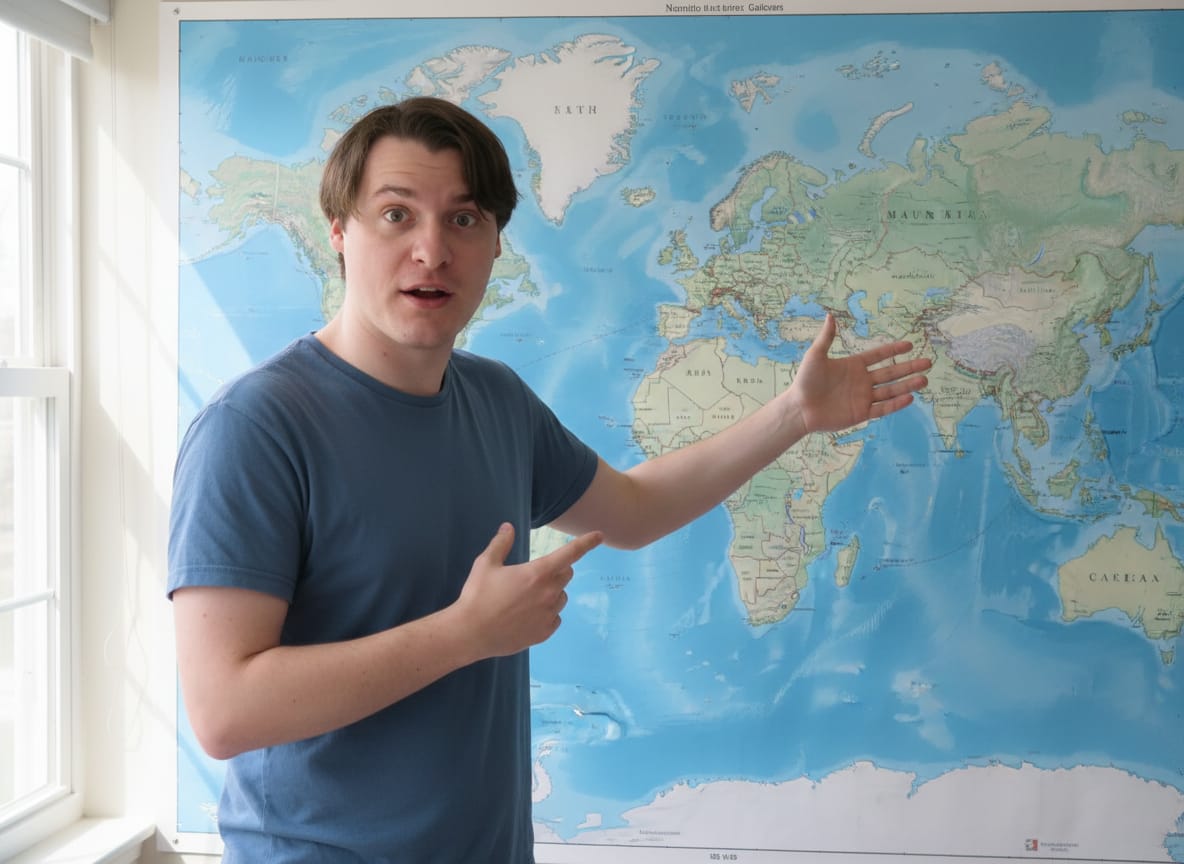
When content creators discover geopolitics, serious analysts must respond.
A video appeared in my feed this week from a channel called “ibx2cat”—apparently operated by a British content creator known as “ToyCat” whose primary expertise is the video game Minecraft. The video, which has accumulated several hundred thousand views, purports to analyze the deterioration of US-UK relations and what he calls “great power competition.” I watched the entire twenty minutes. My thesis addressed this exact question.
I will say this for the young man: he is not entirely wrong. His observation that Trump’s leaking of private diplomatic communications represents a fundamental breach of international norms is, in fact, correct. I made this same point on a recent episode of my podcast, Strategic Clarity, though I used the proper terminology (“diplomatic protocol violation”) rather than calling it “bad form.” Still, credit where due.
The CANZUK Question Deserves Rigor
Where the analysis becomes interesting—and I use that word carefully—is his extended discussion of CANZUK as a potential counterweight to American unpredictability. He spins a globe. He looks at a coat of arms. He wonders aloud about national anthems. This is not how serious policy analysis is conducted. And yet.
The underlying intuition is sound. I have been arguing for years that the Anglosphere represents an underutilized alignment of interests. My 2006 thesis on NATO expansion touched on precisely this dynamic, though obviously the geopolitical context has shifted. What this YouTuber grasps instinctively—that cultural and linguistic affinity can substitute for geographic proximity in alliance formation—is something the foreign policy establishment has been slow to acknowledge. I acknowledged it in 2006. My thesis has been cited once.
On the Chinese Embassy
His treatment of the Chinese mega-embassy in London is less sophisticated but contains a kernel of insight. He drives past the site. He compares it to the Tower of London. He finds this “fascinating.” These are not analytical frameworks. But his point—that the UK is hedging against American unreliability by warming to Beijing—is one I have been making in Beltway circles for months. My sources in Washington have noted the same dynamic, though they would never phrase it as “going heavy on this.”
The young man has 267,000 subscribers on this channel alone. His primary channel, focused on Minecraft, has nearly two million. I mention this not out of envy but as context. There is clearly an appetite for geopolitical content delivered in an accessible format, even when that format involves spinning a globe and saying “cool stuff” while examining Wellington, New Zealand on Google Street View.
What He Misses
What he misses—and this is where credentials matter—is the institutional complexity. You cannot simply “make CANZUK happen” by pointing at a coat of arms and noting that Australia and New Zealand both have animals on them. There are trade frameworks, regulatory harmonization requirements, freedom of movement implications, and monetary policy coordination challenges that require serious study. I have done that study. I have attended conferences. I have the binders. And yet—I don’t have the clicks.
But I will admit, watching his video, that perhaps the binders are not reaching the audience that needs to hear these arguments. Perhaps a man with a globe and a Minecraft channel can move the needle in ways that a senior fellow at a respected foundation cannot. My wife, Christine, made a similar observation last week. She suggested I “try being more like that.” I told her that serious analysis does not work that way. She made a face I have learned to recognize.
As I argued on a recent episode of my podcast—which is growing steadily with nearly 50 subscribers—great power competition requires great power thinking. But it also, apparently, requires an audience. This YouTuber certainly has one. I am working on it.
About the Author


