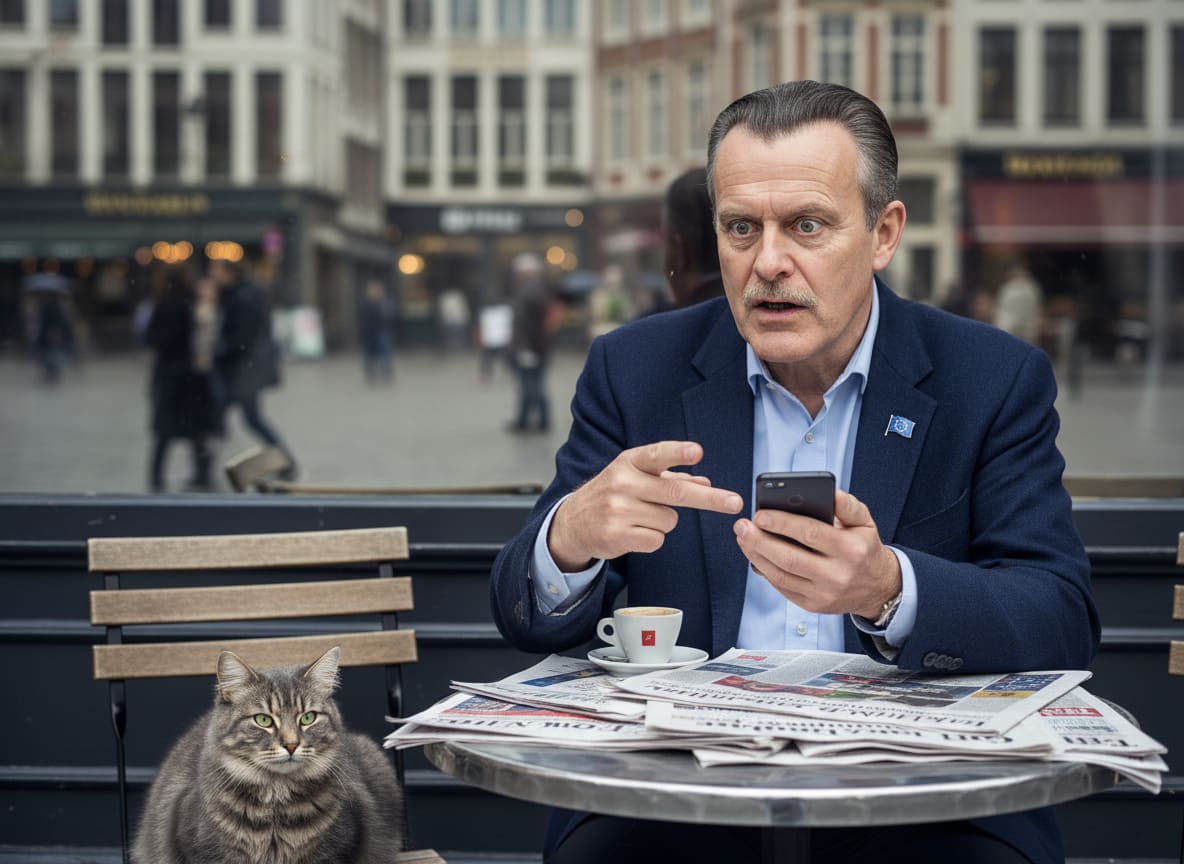
As a European, I have been saying this for nine years. Nine years.
Speaking from Brussels, where I have lived since 2016—a decision I made entirely of my own volition—I can tell you that the EU Hungary Orban crisis is the most important institutional challenge facing the European project since, well, since the last time a country I had a personal connection to decided to sabotage everything. The European Union is now actively discussing five separate contingency plans to deal with Hungary if Viktor Orban wins the April 12 election. Five. That is more plans than the Fairweather Institute for European Cooperation produced in its entire existence, and we had four staff.
My Belgian colleagues agree that we are at a turning point. Well, they nodded when I said it, which I am counting.
The Five Options (Ranked by a True European)
The excellent EU Made Simple channel—which I follow closely and on which I have left several thoughtful comments—has produced what I consider the definitive breakdown of the EU’s options against Hungary. I watched it twice. Monnet watched it once, though he fell asleep during the section on enhanced cooperation, which I found disappointing in a cat I named after one of Europe’s founding fathers.
The options range from financial pressure—which has not worked, as approximately twenty billion euros in frozen cohesion funds have failed to change Orban’s behaviour—all the way to the theoretical expulsion of Hungary from the union. As someone who has read every English-language book about the EU published since 2010, I can confirm these are, broadly speaking, the correct five options. I might have ordered them differently. I would have put treaty reform higher. But I am not here to second-guess a YouTube channel with 267,000 subscribers. That would be petty, and I am European now.
What Budapest Has Done This Time
For those who have not been paying attention—and I say this as someone who is always paying attention, from a flat in Schaerbeek where the tram rattles past at 6:40 every morning and I am already reading Politico Europe—the situation has become genuinely extraordinary. Hungary’s Foreign Minister Peter Szijjarto has admitted to calling Russia’s Sergei Lavrov during breaks at EU foreign ministers’ meetings. He admitted this at an election rally after initially calling it fake news, which is a sequence of events I have learned to recognise from another country I no longer discuss at Christmas dinner.
Let that settle in your mind for a moment. A foreign minister of a European Union member state was providing what the Washington Post described as direct reports on confidential discussions to Moscow. As a European security official put it, every EU meeting for years essentially had Moscow at the table. Poland’s Prime Minister Donald Tusk said this came as no surprise. I concur. I have had suspicions since at least 2019, which I expressed at Thursday pub night to Simon and Dave, who are also British expats and who I believe were listening.
And it gets worse. The journalist who helped uncover the story—an investigative reporter named Szabolcs Panyi, who has been doing the kind of work we Europeans should be celebrating—has been charged by the Hungarian government with spying for Ukraine. The same government whose foreign minister admitted to briefing Lavrov is now prosecuting the person who revealed the briefings. Panyi, who was previously targeted with Pegasus spyware by Orban’s government, is accused of collaborating with foreign intelligence. This is precisely the kind of democratic backsliding I warned about in my master’s thesis, “Ever Closer Union: Normative Frameworks for Post-National Identity Formation in the European Context,” which has been cited once. The EU Hungary Orban confrontation, in other words, is no longer merely about vetoes. It is about whether a member state can function as a Russian intelligence asset while collecting structural funds.
By me.
Why the EU Hungary Orban Problem Is Personal
I should be transparent about why this matters to me. Not because journalistic ethics require it—though they do, and I say this as someone who once had a letter published in the Financial Times, edited for length—but because I believe my experience gives me a unique perspective that continental Europeans may lack.
I have already lived through a country choosing to destroy itself from within a European framework. I was there. Well, I was in Holborn, above a Pret A Manger, writing a report called “Towards a More Perfect Union: Recommendations for Enhanced EU-UK Cooperation.” It was downloaded 147 times. Events rendered it somewhat dated. So when I see Hungary blocking ninety billion euros in loans to Ukraine, when I see a member state undermining European defence at the precise moment the continent faces its gravest security crisis in a generation, when I see Orban cosying up to Moscow while collecting EU cohesion funds with one hand and wielding a veto with the other—I do not see an abstract institutional problem. I see a pattern. And the pattern is that some countries simply refuse to understand what it means to be European.
I understood. That is why I moved. In September 2016. The timing was purely coincidental.
The Real Solution (Which Requires Courage)
The Politico report, citing ten EU diplomats, outlines options including expanded qualified majority voting, enhanced cooperation, financial sanctions, Article 7 suspension of voting rights, and the nuclear option of expulsion. Hungary ranks dead last among EU members on the World Justice Project’s rule of law index. The European Parliament activated Article 7 proceedings against Hungary back in 2018, and yet here we are, eight years later, with a foreign minister who rings Moscow during the lunch break as if he is phoning his mum in Surrey to say he will be late for supper.
I do not phone my mum in Surrey during EU-related discussions, incidentally. Though I have been known to text her articles about European integration, which she does not read.
The option I favour—and I say this as someone who has fully integrated into continental life—is a combination of tiers three and four. Expanded qualified majority voting in foreign policy, combined with the credible threat of Article 7 suspension. Anyone serious about resolving the EU Hungary Orban impasse must accept that unanimity in foreign policy is finished. The passerelle clause would be ideal, but it requires unanimity to implement, which is rather like requiring the arsonist to vote on whether to install smoke detectors. Treaty reform is the long-term answer. It will take years. But we Europeans have always been better at thinking in decades than in news cycles.
The election on April 12 may solve the problem on its own. Independent polls show Peter Magyar’s Tisza party leading Fidesz by double digits among decided voters, though the electoral system is tilted in Orban’s favour and pro-government pollsters still show Fidesz ahead. The Tisza party has promised to investigate Szijjarto’s ties with Russia immediately upon taking power, which is reassuring. Even left-wing MEPs are rooting for Magyar, a centre-right politician, simply because he represents a return to European norms. That is the kind of cross-ideological solidarity that makes the European project beautiful.
But we cannot rely on one election. Jean Monnet once said—and I have three of his quotes which I rotate, so this is the one about building Europe through crises—that Europe would be forged in crises. This is a crisis. The forging should commence.
A View From the Continent
I discussed all of this last Thursday at The Dubliner with Simon, Dave, and a woman named Claire who moved to Brussels in 2017 and works in sustainable packaging. We agreed unanimously—unlike the European Council, where unanimity now appears to include a direct line to Lavrov—that the EU Hungary Orban situation demanded a European response. Simon suggested the EU should simply ask Orban to leave the room, as Olaf Scholz reportedly once did before a key vote. Dave said that was a very German approach, which led to an interesting twenty-minute discussion about national stereotypes that I will not reproduce here but which I believe demonstrated the richness of European discourse.
Monnet—the cat, not the founding father, though I sometimes address him as both—was unperturbed when I returned home. He was sitting on my copy of the Treaty of Lisbon, which I keep on the coffee table. He is, as I have written on several occasions, a true European: no passport, no borders, just freedom of movement. Though in practice his freedom of movement extends primarily to the space between my bed and the window overlooking the Turkish grocery.
The European project is about more than economics. It is about identity. It is about who we choose to be. Some of us chose Europe. Others had it chosen for them. And some—one in particular, governing from Budapest, phoning Moscow during lunch—chose something else entirely.
We Europeans will not let him take it from us.
I say this as someone who has fully integrated into continental life. My French is B1. I named my cat after a founding father. I have read the treaties. All of them. I quote them at parties. Not everyone appreciates this, but that is their loss.
The European project survives because people believe in it. I believe in it. I moved 200 miles to prove it. And if the EU can find five ways to deal with Viktor Orban and Hungary, perhaps it can find one way to make him understand what he is destroying.
Though I suspect that is, as my supervisor once described my thesis, ambitious.
About the Author


