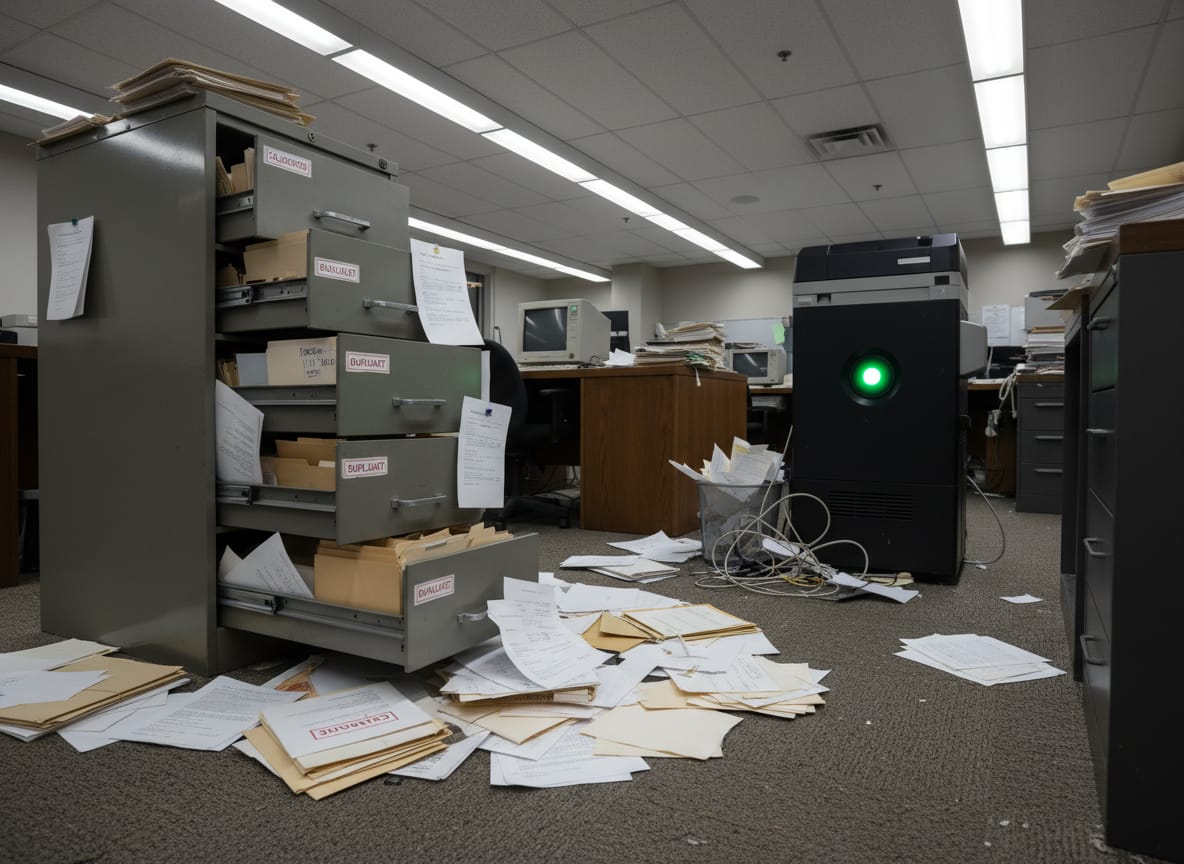
Department says records documenting FBI’s four interviews with underage Trump accuser were not hidden, merely located somewhere nobody could find them
WASHINGTON — The Department of Justice has now confirmed a pattern of withholding, deleting, and inadequately explaining the absence of Epstein files DOJ records documenting the FBI’s repeated interviews with a woman who accused President Trump of sexually assaulting her as a child, according to multiple investigations by independent and mainstream journalists whose findings the department has been forced to acknowledge one disclosure at a time. The Epstein files DOJ controversy now spans deleted documents, contradictory official explanations, and dozens of pages the department admits it possesses but has declined to publish.
The fundamental facts of the case are not in dispute. The FBI interviewed the woman — whom DOJ identifies as a Jeffrey Epstein victim from the early-to-mid 1980s — at least four times in 2019, under penalty of law for lying. An internal FBI email from last summer described her as “one identified victim” who “claimed abuse by Trump but ultimately refused to cooperate,” language that former senior DOJ officials say indicates the Bureau wanted to pursue a criminal investigation based on her account.
What is very much in dispute is why the Justice Department released only one of her four FBI interviews when it published 3.5 million pages of Epstein-related records — and why, when a journalist discovered that a key evidence index had been deleted from the department’s public database, the DOJ restored the document without alteration and explained that it had been removed for a “redaction review” that apparently resulted in zero redactions.
Legal Experts Divided On Whether Coincidence Explains Everything
The story has unfolded in a sequence that legal experts describe as either “deeply concerning” or “probably fine,” depending on their relationship with the current administration. The controversy follows earlier questions about the Epstein file release timeline and represents the most significant challenge to the department’s claim of compliance with the federal disclosure law.
Reporter Roger Sollenberger first revealed in February that the Epstein files contained evidence of the FBI’s interviews with the Trump accuser. He subsequently reported that DOJ had deleted from its public database a case index showing that all four of the woman’s interviews had been provided to Ghislaine Maxwell’s defense team — but that only one had been released to the public. Days after his reporting, the document reappeared on the DOJ website, apparently unchanged.
NPR’s Stephen Fowler then identified 53 pages that appeared to be missing from the public database. Under sustained media pressure, the DOJ eventually released three additional FBI interview summaries totaling 16 new pages. But as Fowler reported after the release, at least 37 pages remain unpublished, comprising FBI agent field notes from the first three interviews, a law enforcement report, and license records.
The department’s explanation for the original omission was that the three withheld interviews were “duplicative” of the one it had already published. Legal analysts noted that three separate FBI interviews conducted on different dates would, by definition, contain different information, making the word “duplicative” a creative choice. When the DOJ later applied the same term to the still-missing 37 pages of field notes, a spokesperson told The Daily Beast the notes “contain the exact same information” as the published interview summaries — a claim that former DOJ officials said was almost certainly inaccurate, since field notes routinely contain observations, context, and details that do not appear in final reports.
Epstein Files DOJ Released 3.5 Million Pages, Just Not The Ones About The President
The DOJ’s own prior statements have further complicated its position. In December, the U.S. Attorney for the Southern District of New York, Jay Clayton, told a federal judge that FBI files predating the Maxwell case “were not themselves produced under the Protective Order” and could have been processed and published without restriction. This would include the Trump accuser’s records. The department did not explain why, if no legal barrier existed, the files were not released with the rest of the Epstein documents.
The New York Times reported Wednesday that the woman’s records would have undergone at least three separate levels of review, including at the most senior level, making it unclear how the department expects its “clerical oversight” explanation to account for the fact that the most politically sensitive records about the sitting president were specifically the ones that went missing.
Meanwhile, an independent fact-check by the South Carolina Post and Courier corroborated numerous biographical and historical claims the woman made in her interviews. The Miami Herald confirmed, through a DOJ source, that the FBI considered the woman credible and “would not have interviewed her four times if they thought she was lying.” The White House has pointed to the woman’s “extensive criminal history,” a characterization that public records contradict, according to the Herald’s reporting.
Maxwell’s Lawyers Offer To Explain President’s Innocence In Exchange For His Help Getting Her Out Of Prison
Complicating the department’s posture is the question of Ghislaine Maxwell, who was convicted of sex trafficking children with Epstein in 2022. Maxwell’s legal team possesses all four of the accuser’s FBI interviews as part of pre-trial discovery — meaning that by withholding three interviews from the public while Maxwell retained them, the DOJ effectively granted the convicted trafficker exclusive access to material about the sitting president that federal law required be made available to everyone.
Maxwell sat for a proffer session with Deputy Attorney General Todd Blanche — who previously served as Trump’s criminal defense lawyer — in July, then was transferred without explanation to a minimum-security facility. She subsequently took the Fifth in closed-door congressional testimony but used the occasion to appeal for presidential clemency. Her lead counsel stated that Maxwell “is prepared to speak fully and honestly if granted clemency by President Trump” and that both Trump and former President Bill Clinton “are innocent of any wrongdoing.”
“Ms. Maxwell alone can explain why,” the statement added, “and the public is entitled to that explanation.” Legal scholars described the formulation as either “an extraordinary public offer” or “something else entirely.”
Rep. Thomas Massie, R-Ky., recently expressed frustration on ABC News about the DOJ’s continued invocation of “deliberative-process privilege” to withhold similar records, making him one of several Republican members of Congress publicly dissatisfied with the department’s transparency on the Epstein files.
Mueller Report Precedent Goes Unmentioned
An element that has received less attention is the Office of Legal Counsel guidance establishing that the government may investigate a sitting president for potential crimes but cannot pursue charges while that president remains in office. The Mueller Report, published just months before Epstein’s arrest and the woman’s initial FBI contact in 2019, explicitly outlined this framework, stating that the special counsel’s team “conducted a thorough factual investigation in order to preserve the evidence when memories were fresh.”
Former DOJ officials told Sollenberger that this precedent would have been directly relevant to the FBI’s handling of the woman’s accusations against Trump, yet no records of any internal discussion about the OLC guidance have been released — or acknowledged to exist.
In her fourth and final interview, FBI agents did not correct the woman’s mistaken belief that the statute of limitations had expired on potential charges. Federal law imposes no statute of limitations on child sex trafficking.
The DOJ has stated that there are no ongoing investigations related to the Epstein case, which would mean the file on this woman’s accusations was closed at some point. No record of that closure has been produced. Former officials say such a disposition record would almost certainly exist, and the internal FBI email from last summer — six years after her interviews — indicates as much.
That same email contains an attachment: an Excel spreadsheet labeled “Updated_Case_Index” that does not appear to have been included in the public database. The file name appears in at least two additional FBI email chains from earlier in 2025 that were released with the Epstein files.
A DOJ spokesperson directed inquiries to the department’s previous statement confirming the publication of 3.5 million pages in compliance with the Epstein Files Act, adding that the department “remains committed to transparency.” The spokesperson did not address questions about the specific records that remain unpublished or the deleted-and-restored case index.
Former DOJ officials from both parties said the department could produce all remaining FBI records related to this woman immediately. The department has not indicated whether it intends to do so.
About the Author


