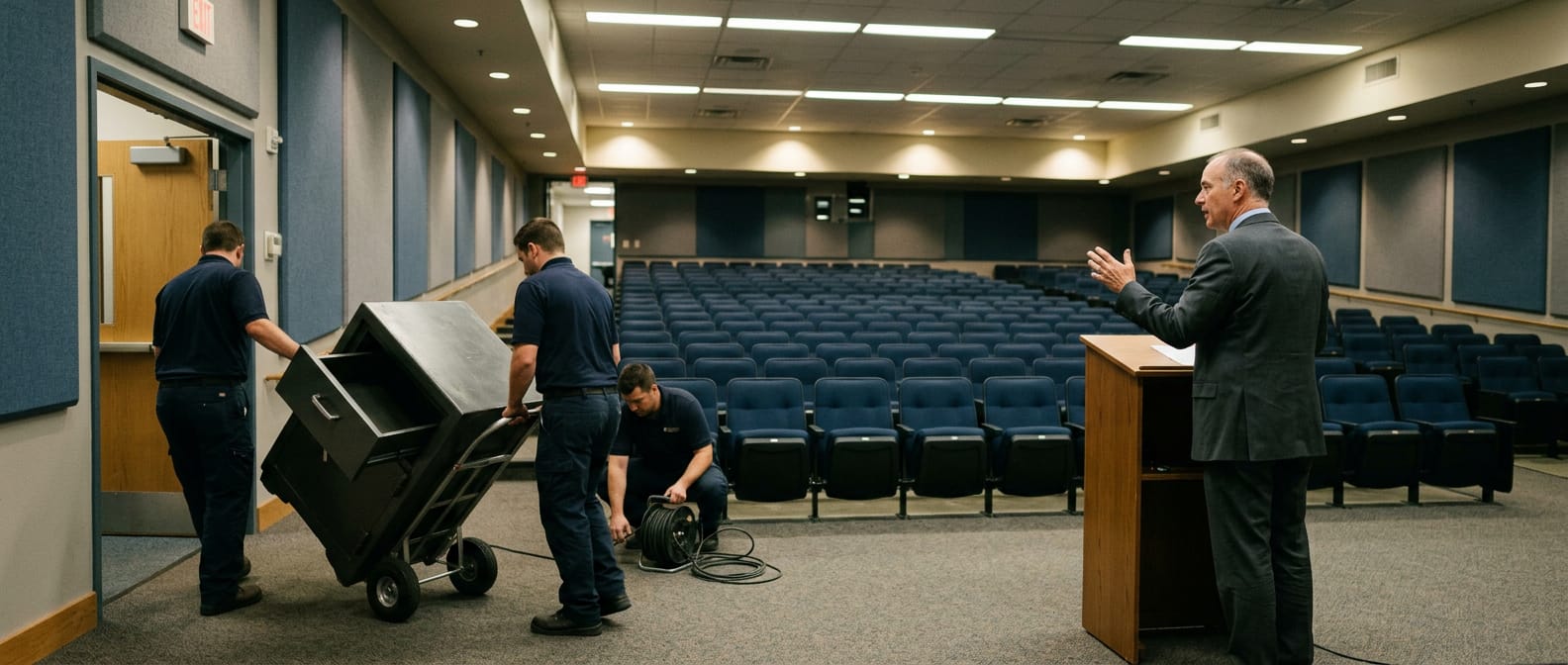
The Navy’s top officer told sailors a scheme of maneuver was in the works. It runs 212 pages, and its air-defense appendix covers nothing with cushions.
ARLINGTON, Va.—Navy planners have turned the scheme of maneuver sailors were told about in August into a 212-page operations order for recovering household goods from the missile-damaged Bahrain naval base, and the order’s air-defense appendix rules that none of the couches qualify for Patriot cover, according to a copy reviewed by Newswax.
The phrase comes from Adm. Daryl Caudle, the chief of naval operations, who was asked at an Aug. 31 town hall about household goods displaced when Iran struck the base at the start of the war. “We’re not getting back in there anytime soon,” Caudle told the seaman who asked. “I just want to be completely honest with that. But we’re working real hard to develop a scheme of maneuver in order for you to get your things.”
“Anything that comes out of that base has to be defended on the way out,” said a Navy planner who worked on the order and spoke on condition of anonymity because it has not been released. “We looked very hard at what we are able to defend. It is a short list.”
What Leaves the Bahrain Naval Base First
Iranian missiles and one-way attack drones hit the Bahrain naval base, formally Naval Support Activity Bahrain and the headquarters of the Fifth Fleet, on Feb. 28, after the United States and Israel began striking Iran. At the time, the Pentagon said the strikes had not significantly affected military operations. Roughly 1,300 dependents were evacuated, and families outside Bahrain have not been authorized to return for their property. According to the Navy, a service member outside the country may designate a representative to ship household goods on the member’s behalf.
Phase One of the order is built around that representative. Representatives form a 14-person surrogate element, briefed on photographs each household submits, and the contents of every home are divided between two lists. One is headed high-value items. The other, which the order calls goods of opportunity, covers anything a surrogate may pick up if already passing it.
“A sailor sends us a picture of a floor lamp,” the planner said. “We brief the lamp. The surrogate goes in knowing what it looks like, where it was last seen, and what to do if it is not where the photograph says it is.”
Appendix 11 and the Three-Seat Sectional
By late August the war had consumed about 65 percent of the country’s Patriot interceptors, according to figures from the Center for Strategic and International Studies reported by the Associated Press, as Newswax reported this month. Each PAC-3 interceptor costs an estimated $4 million, Defense News has reported. On Aug. 17, criticizing South Korea for declining to help, the president described the conflict as “a very easy military operation in Iran.”
Appendix 11 to Annex C, the order’s air-defense section, assigns interceptor cover by the declared value of each item and sets the threshold at the cost of one interceptor. No item in the order meets it. The highest declared value belongs to a 2019 pickup truck listed at $41,200, which the appendix scores at 1.03 percent of a PAC-3.
“We ran a three-seat sectional against a PAC-3,” the planner said. “The sectional is going to have to take its chances.”
Thirty Days’ Notice Through Diego Garcia
Since the strikes, the Navy has relied on a logistics hub at Diego Garcia, an Indian Ocean atoll more than 2,000 miles from its carrier strike groups. Sailors aboard one littoral combat ship had to order food 30 days in advance, Navy Times has reported. A Navy FAQ issued in May said undelivered household-goods shipments would go into government storage pending an “all clear.”
Phase Two adopts the 30-day rule. Goods leaving the Bahrain naval base travel through Diego Garcia, and a sailor who wants a couch delivered must request it 30 days before it leaves the atoll. The delivery address is drawn from the designated place that evacuated families must report to the Navy by Nov. 30. Phase Three, delivery, is listed as conditions-based. The order defines the condition as the all clear, and the all clear as the first day a surrogate can carry a box to a truck without requesting air cover.
The Last American Presence at the Bahrain Naval Base
In August, The Washington Post reported that the Pentagon was weighing a smaller presence in the Gulf and might not rebuild its damaged bases as they were before the war. The paper wrote that the damage had prompted a “once-in-a-generation chance for the Pentagon to reconsider its presence” in the region. Writing in The Atlantic this week, the military historian Phillips Payson O’Brien called that one way to spin the situation. Defending such facilities against Iran, he added, “is not something that the U.S. military can currently do.”
Elsewhere in the Gulf, the Trump Organization has six developments under way in Saudi Arabia, the United Arab Emirates, Qatar and Oman, according to The National. One is an 80-story tower on Dubai’s Sheikh Zayed Road. It is 80 percent sold.
A senior Navy official familiar with the order said the household goods still inside the Bahrain naval base are now the largest American presence at the Fifth Fleet’s headquarters. Moving them, the official said, would require a decision about that presence. “If the sofas come out, that is a withdrawal,” the official added. “Nobody has signed a withdrawal.”
Planners have held the order at Phase One pending that decision. The three-seat sectional remains in position.
Developing.
About the Author